Comm 479W :American Film History

From Still Images to the Silver Screen
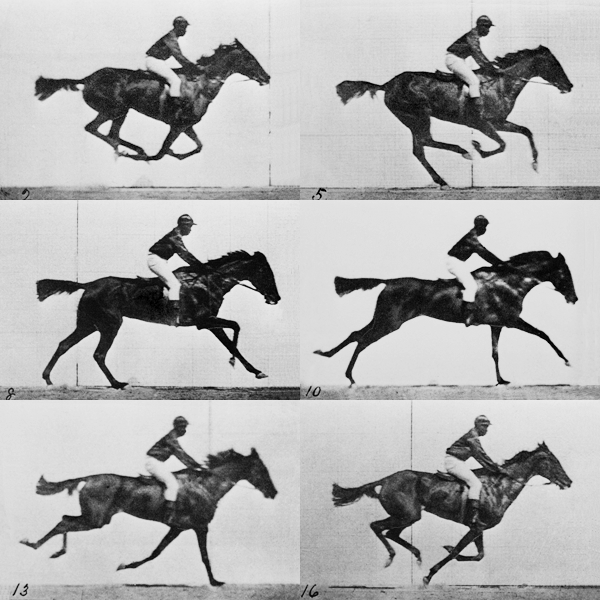
When we watch movies today, it's so easy to forget how much had to happen before cinema matured into what it is now. Movies don't just become movies overnight from one invention or one person; it takes a community. Photography, experiments with movement, projection, cameras, filmmakers, performers, and audiences all play a huge part.In today's post, we'll talk about how films developed from pre-cinema and early American cinema into the Silent era. What caught my attention the most is seeing how quickly the pictures have changed over time, from simple storytelling to big business and an important part of American culture. Before movies existed, people tried to experiment with projected images and the illusion of movement, now known as "movies " or "motion pictures." An important invention was the "Magic Lantern", an early projector for image projection. (Magic Lantern, 2024) As projection combined with motion-toy technology, audiences could experience a sequence of images that appeared to move. Another important idea was persistence of vision. (Anderson & Fisher, 1978, pp. 3-8) The course lecture explains how one image briefly remains in our perception while the next appears, helping a rapid sequence of still images appear as continuous movement. Eadweard Muybridge illustrated his ideas through his famous photographs of a galloping horse. He positioned cameras on the sides of a racetrack to capture different stages of the horse’s movement. When viewed in sequence, the still photographs created a sense of motion. (Galloping Horse by Eadweard Muybridge, 1878).
Edison , Dickson , and Lumière Brothers
Thomas Edison and William Dickson also played an important role in developing motion pictures. They developed the Kinetograph, which could record a sequence of pictures on film. The Kinetoscope then let people view recorded moving images one at a time. In France, Auguste and Louis Lumière developed the cinématographe, which was portable and could project moving images. Their public exhibition in Paris on December 28, 1895, included Workers Leaving the Factory and became an important moment in early film history. What I find interesting about these early films is how ordinary their subjects could be. Something as simple as workers leaving a factory became fascinating because audiences had never experienced everyday life reproduced as projected moving images.

Movies Become Entertainment
Once people became interested in moving pictures, cinema quickly developed into commercial entertainment. Around 1905–1907, nickelodeons became established as places where audiences could watch programs of short films. They received their name because admission cost a nickel. The growth of movies also created competition over who would control the new industry. The Motion Picture Patents Company (MPPC) was formed in 1908 and used important patents to influence prices, licensing, production, distribution, and exhibition. Film also faced regulation very early. The lecture discusses an important event on Christmas Eve 1908, when New York City mayor George McClellan closed the city’s nickelodeons. Early filmmakers gradually discovered that movies could do more than record something happening in front of a camera. Edwin S. Porter helped develop visual storytelling. His The Great Train Robbery (1903) used multiple shots to construct a narrative and demonstrated techniques such as cross-cutting. The movie also included its famous close-up of a gunman.D. W. Griffith later became influential in developing what the lecture calls the language or “grammar” of filmmaking. His The Birth of a Nation (1915) is important to film history for its filmmaking techniques. Still, D.W. Griffith's historical importance never separated from its deeply racist content and its connection to the resurgence of the Ku Klux Klan. This is an important reminder that recognizing a film’s influence does not mean neglecting or excusing the harmful ideas it promoted.
Women in Early Cinema

American filmmaking was initially concentrated in places such as New York and Chicago, but the climate made year-round outdoor shooting difficult. Growing demand for movies contributed to production moving west and the development of Hollywood. By the Silent Era, Hollywood was becoming much more than a location where movies were filmed. It was becoming an entire industry. Movies in the Roaring Twenties: Silent cinema grew alongside the Jazz Age and Roaring Twenties, a period of enormous social change. The lecture connects this era with urban growth, labor reform, women’s suffrage, Prohibition, jazz, and changing social behavior. Silent movies appealed to America’s large immigrant population because visual storytelling did not depend entirely on spoken language. Images, expressions, gestures, and action could communicate across language differences.
The Beginning of Film Comedy
Comedy was developing at the same time.Mack Sennett became an important figure through his work at Keystone, where he worked with performers including Charlie Chaplin, Mabel Normand, and Fatty Arbuckle. His films emphasized physical humor, exaggerated characters, chaos, and action. The Keystone Kops, with their ridiculous and clumsy police officers, became a recognizable part of early film comedy. Sennett also produced Tillie’s Punctured Romance (1914), identified in our textbook material as the first feature-length comedy starring Chaplin. Even though some of these movies may seem simple today, they helped establish the foundation for later screen comedy.
Hollywood Takes Over
American filmmaking was initially concentrated in places such as New York and Chicago, but the climate made year-round outdoor shooting difficult. Growing demand for movies contributed to production moving west and the development of Hollywood. By the Silent Era, Hollywood was becoming much more than a location where movies were filmed. It was becoming an entire industry. Movies in the Roaring Twenties: Silent cinema grew alongside the Jazz Age and Roaring Twenties, a period of enormous social change. The lecture connects this era with urban growth, labor reform, women’s suffrage, Prohibition, jazz, and changing social behavior. Silent movies can appeal to America’s large immigrant population because visual storytelling did not depend entirely on spoken language. Images, expressions, gestures, and action could communicate across language differences.
Hollywood Creates the Movie Star
One of the biggest changes during the Silent Era was the rise of movie-star culture. Audiences weren’t interested only in movies anymore. They wanted to know about the actors appearing in them. Stars came to represent beauty, romance, wealth, fashion, and success. Mary Pickford became one of Hollywood’s earliest major female stars. Her popularity eventually gave her real business power. In 1919, she joined Douglas Fairbanks, Charlie Chaplin, and D. W. Griffith to establish United Artists, giving these successful artists greater control over the development, production, and marketing of their movies. Theda Bara showed another side of celebrity: Fox created an exotic public identity around her, demonstrating that studios could actually manufacture a star’s image. Theda Bara's famous “vamp” persona is established through films such as A Fool There Was (1915). Then there was Rudolph Valentino, one of the Silent Era’s greatest romantic stars. The lecture describes the Italian-born actor as an icon and sex symbol associated with the “Latin Lover” image. His sudden death in 1926 caused an enormous public reaction and showed just how emotionally connected audiences had become to movie celebrities. Clara Bow, the famous “It Girl,” became another symbol of the Roaring Twenties. At the height of her fame, the lecture says she received more than 45,000 fan letters per month. Gloria Swanson also became a prominent actress and fashion icon, particularly through her work with Cecil B. DeMille.

The Studio System
As stars became famous, movie studios grew extremely powerful. Major Hollywood businesspeople included Carl Laemmle, William Fox, Adolph Zukor, Marcus Loew, and the Warner brothers. Studios increasingly controlled production and their employees through contracts. In 1915, Carl Laemmle moved Universal’s production operations to the enormous Universal City complex in California. The studio system increasingly brought different parts of movie production together under centralized management.MGM became one of the great success stories of the Silent Era. Marcus Loew combined production interests with his theater business, creating a company involved in production, distribution, and exhibition. This system of vertical integration gave major studios enormous control over how movies reached audiences.
Scandals and Hollywood Self-Regulation
Movie stardom also created problems for the studios. Audiences became fascinated with celebrities’ private lives, and scandals involving Hollywood stars created public pressure on the industry. In 1922, the studios formed the Motion Picture Producers and Distributors of America (MPPDA). Will Hays was selected to lead the organization and, with the public, produce entertainment responsibly. Self-regulation wasn’t only about protecting Hollywood’s reputation. It also helped studio executives regain control over their increasingly powerful stars and industry.
Masters of Silent Comedy
The Silent Era also produced some of film history’s most important comedians. Charlie Chaplin became internationally famous as “The Tramp.” He wasn’t simply an actor. According to the lecture, Chaplin wrote, directed, produced, edited, starred in, and composed music for many of his movies. His comedy combined slapstick with stories about the Tramp struggling against adversity and often included social and political themes. Buster Keaton became another important comedian, filmmaker, stunt performer, and writer. Harold Lloyd was another major figure in Silent Era comedy. Their success demonstrates how sophisticated visual storytelling had become. They could communicate humor, emotion, character, and entire stories without relying on spoken dialogue.
Final Thoughts
Looking at Pre-Cinema, Early Cinema, and the Silent Era together helped me realize that film history is about much more than movies. Cinema developed through a combination of technology, creativity, business, immigration, gender, social change, celebrity, and power. The magic lantern and motion pictures experimented with projection and movement. Muybridge's photographs could represent motion. Edison, Dickson, and the Lumière brothers helped develop motion-picture technology. Filmmakers like Porter explored new ways to tell stories, while women such as Alice Guy, Gene Gauntier, and Lois Weber contributed behind the camera. Hollywood transformed those experiments into a massive industry. Studios gained control over production, distribution, exhibition, and performers while movie stars became some of the most recognizable people in American culture. What started as an experiment with still images eventually became the silver screen—and the foundation of the movie industry we know today.
Work Cited
Lewis, Jon. American Film: A History. W. W. Norton, 2019. Accessed 30 August 2026.
Comments